

How To Build A Quiet, Profitable Business On Substack (Without Making Your Newsletter Paid)


Charging for your newsletter is not the only way to make money on Substack.
It might not even be the best way.
Every guide you’ll find follows the same script. Grow your list. Build a paid tier. Lock your best content behind a paywall. That’s the model everyone talks about because it’s the easiest one to explain.
But it’s not the only model. And for sensitive solopreneurs, it’s often not the right one either. The pressure of writing something worth paying for every single week is something we know all too well. That kind of weight rarely moves us forward. More often, it leads us straight into paralysis.
Here’s what I want you to try instead.
Give your best content away. Freely. Consistently. And use that generosity to build the kind of trust that makes people want to buy your products, join your course, or work with you directly.
Your newsletter should provide something useful each week. And when you eventually open a coaching spot or launch a new offer, your readers won’t hesitate. The trust is already there.
That’s the model I want to walk you through.
But first: why Substack?
For three reasons.
You own your audience. An email list is yours forever and you do not depend on an algorithm for your newsletter to reach your readers.
The setup is simple. You can start publishing within hours. For sensitive solopreneurs, removing friction is the difference between doing the thing and endlessly preparing to do the thing.
Notes is the best organic growth tool available right now. More on that below. But the short version: there are more readers than writers on Substack Notes, there are zero ads, and every person there is looking for something to read and learn.
Step 1: Position for the right reader, not everyone
This is where most people go wrong. They try to write for everyone. Broad topics, vague niche, no one in particular.
Your newsletter name and subtitle have one job: make the right person immediately recognize that the newsletter is for them.
That means naming your niche clearly. Then naming the specific problem you solve. Then naming what you deliver and how often.
Ask yourself three things: Who is this for, specifically? What is the real problem I solve? What tangible thing do I give them each week?
If a stranger could read your newsletter name and subtitle in five seconds and know whether they belong here, you’ve nailed it.
Specificity is also protective. The clearer you are, the more you attract readers who genuinely resonate with your work.
Step 2: Map your offer ecosystem
This is the step that changes everything.
Your newsletter is not the thing you sell. It’s the thing that earns the trust that makes people want to buy.
Think of it as a ladder. Your newsletter is the foundation: free, generous, consistent. From there, readers can climb.
Entry-level products first: a template, a workbook, a mini-course priced as an easy yes.
Then something more substantial: a full course, a group program.
And at the top, your most intimate offering: 1:1 coaching or consulting, for the readers who want to work with you directly.
You don’t need all of these to start. You need to know the ecosystem exists, and that your newsletter feeds it.
Every issue you write is quietly doing a job. It’s showing your reader who you are, what you understand about them, and why your paid work is worth their time and investment.
Step 3: Write content that earns trust and leads somewhere
Here’s the reframe that unlocks this model: stop looking for topics. Start looking for problems.
Every reader of your newsletter has a specific set of struggles. Your job is to find those struggles, solve them in writing, and give your reader something tangible to walk away with. A framework. A tool. A practice with a name.
One reliable structure for this:
Problem. Open with a moment your reader will recognize. Not a vague situation, a specific, felt experience. The kind where she thinks that’s exactly it.
Insight. Explain why this problem exists. The pattern underneath it. The thing she couldn’t see before.
Solution. Walk through it step by step. Be precise. Name your tools.
Asset. Give your reader something to keep. A prompt. A checklist. A simple framework she can use this week.
When you write this way, your newsletter builds a quiet, accumulating sense of: she understands me. She helps me. I want more of what she offers.
Step 4: Use Notes with intention, not volume
You do not need to post five times a day. You do not need to be everywhere.
What you need is to show up consistently with content that is actually worth reading.
Notes is currently the best organic discovery tool on Substack. There are more readers than writers, and the feed is designed to get people to subscribe to newsletters.
The formats that work well:
A short paragraph that makes one clear point. White space matters: people skim on their phones, and a wall of text gets scrolled past.
A question your specific reader has been quietly asking herself. Questions boost engagement and signal to the algorithm that the content is worth surfacing.
A snippet from your latest newsletter. To do this: go to your newsletter page, highlight the passage you want to share, right-click, and select Restack. It is one of the most underused features on the platform.
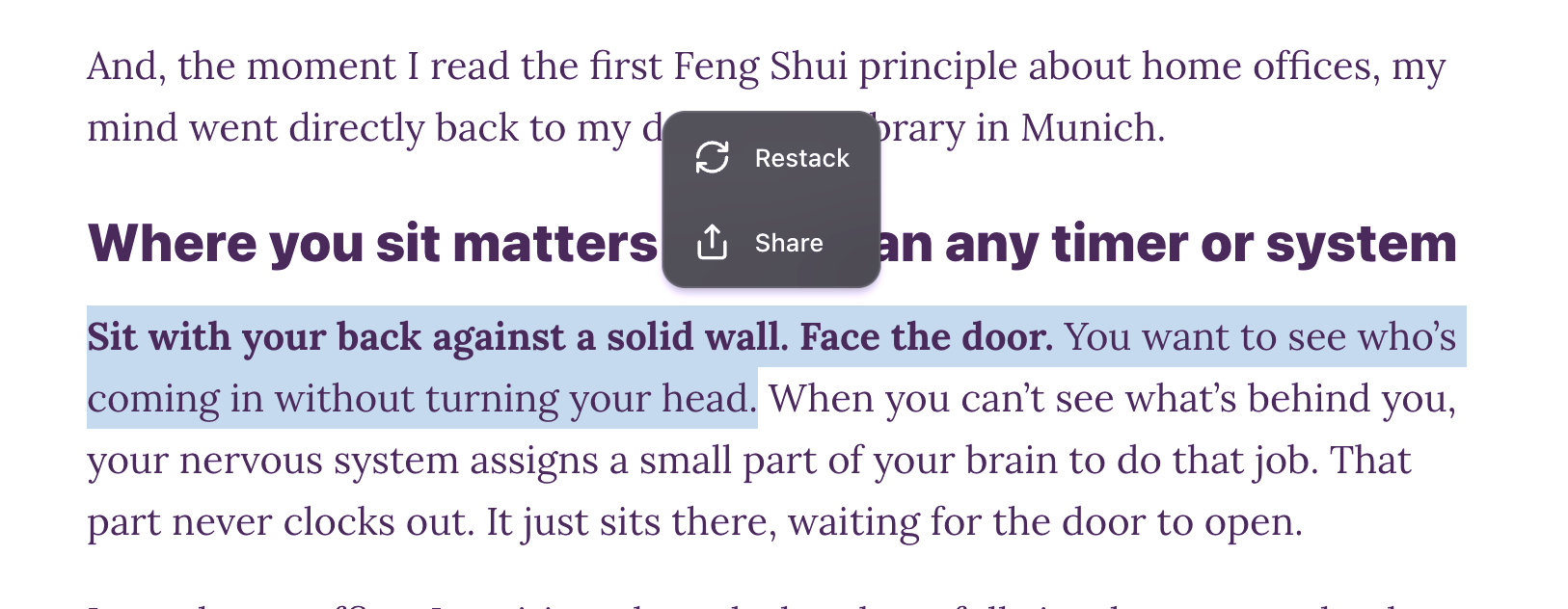
Notes is there to help the right people find you.
Step 5: Measure revenue, not subscriber count
This is the quiet business difference.
Growth-at-all-costs advice will always tell you to track subscribers. More is better. The number going up means it’s working.
But that metric tells you nothing about whether your business is working.
Track this instead: How many readers became customers? Which topics led to product purchases? How many coaching inquiries came from specific newsletters you wrote?
Double down on what works.
A list of 800 highly engaged readers who trust you and buy from you is worth more, in every way, than a list of 8,000 who skim and forget.
Build slowly. Measure what actually matters.
The core truth underneath all five of these steps is this: generosity is a business strategy. A sustainable one. The kind that doesn’t require you to perform, to hustle, or to lock your best self behind a paywall. Robert Cialdini called it the reciprocity principle, and it explains exactly why this model works. I’ll be writing about it in a future issue.
The quiet path is a sustainable one. And for sensitive solopreneurs like us, it’s the only way.
With love,
Cristina