
Sensory-Friendly Home Office for Quiet Deep Work Sessions
How Designing Your Home Office Helps You Be More Focused and Calm as a Highly Sensitive Woman.


Picture this.
During my PostDoc in Munich, I had an assigned desk which faced a window but had a door positioned directly behind my chair. A door that people used often, walking in and out to fetch books. Part of my brain was constantly tuned to that door. I would hear it open, startle and lose the thread. I took a lot of notes in that library. But I couldn’t concentrate enough to actually write, I had to retreat to the safety of my apartment to be able to keep enough focus.
I’ve been dipping into Feng Shui lately. (I know. Bear with me.) It is truly fascinating how these ancient spatial practices were already mapping out the exact neurological responses that neuroscientists are proving in recent years.
And, the moment I read the first Feng Shui principle about home offices, my mind went directly back to my desk at the library in Munich.
Where you sit matters more than any timer or system
Sit with your back against a solid wall. Face the door. You want to see who’s coming in without turning your head. When you can’t see what’s behind you, your nervous system assigns a small part of your brain to do that job. That part never clocks out. It just sits there, waiting for the door to open.
In my home office, I positioned my desk to have full visual access to the door, and behind me is a wall of books to “keep my back supported”. I used to face the shelves, but it was a huge distraction. I would sit down to work, and I immediately wanted to pull out something to check or add to my mental list of books I wanted to read. So I turned around, and now I have nothing in front of me that steals my attention.
Clear everything in your peripheral vision.
Your brain is scanning whatever is in your peripheral vision. That pile of papers. The mug you meant to bring to the kitchen. Every object in your peripheral field is a micro to-do. You don’t notice it consciously, but your brain does.
I got into the habit of resetting my desk every evening. Takes two minutes. And when I sit down in the morning, there’s nothing asking anything of me yet. Just the work ahead.
Put a nature reminder where you can see it
I recently read The Signs by neuroscientist Dr. Tara Swart, and she writes about neuroaesthetics, the study of how the arts, beauty, and our environment affect our brains and bodies, and how we can use those effects to grow and think better. She writes that rooms with wooden surfaces and curved shapes reduce stress compared to spaces with sharp edges and metal. Not because they look nicer. Because your nervous system is responding to them non-consciously, all day.
I keep a plant on my desk, and during the summer, I cut flowers from my garden and put them nearby. This is rooted in a concept known as biophilia: our innate biological need for connection with nature. When you place living things in your workspace, you’re sending your nervous system a signal: growth is happening, things are okay. It lowers stress and signals safety to the brain.
Switch off the overhead lighting immediately
When I was working as a researcher, I got to spend plenty of hours in specialized libraries, and guess what? They all had insanely bright overhead neons. By noon, I was completely depleted and had to retreat home to be able to continue working.
For us Highly Sensitive People (HSPs), intense overhead lighting can activate a subtle fight-or-flight reaction. This is a persistent, low-level state of alertness that prevents our nervous system from settling into deep focus.
A warm-toned desk lamp is the sensory solution. Because this warmth mimics the natural spectrum of a sunset, your brain interprets the environment as secure, telling your nervous system it’s safe to actually work.
Pick a scent and use it every single time you sit down to work
I use star anise in a diffuser.
The scent itself doesn’t matter. What matters is consistency.
For a Highly Sensitive Person whose nervous system is often running on high alert, a specific scent used only during work becomes a sensory anchor. Your brain learns the association: this smell means we are safe, we are in our workspace, and it is time to focus. It creates a sensory boundary between your home life and your work life, which matters enormously when the two happen in the same building.
Nature sounds tell your brain everything is fine
Here’s something I find genuinely fascinating: in nature, silence is dangerous. When there’s no sound, predators are near. When birds are chirping, the environment is safe. Your nervous system has known this for about 200,000 years!
I used to work in silence, but now, I always have birdsong playing in the background. It’s such a gentle way to signal your brain that you are safe and you can focus on the task ahead.
For us HSPs whose ears are constantly scanning for threat, birdsong is a continuous, subconscious all-clear. Our prefrontal cortex (the part actually doing the work) relaxes. And when it relaxes, it thinks and performs better.
My current Home Office Setup
My back is against a wall of books. I have a plant, and flowers from the garden during summer. A star anise diffuser running. Birdsong in the background.
These tiny adjustments have changed how I feel by the end of the day, and how productive I am.
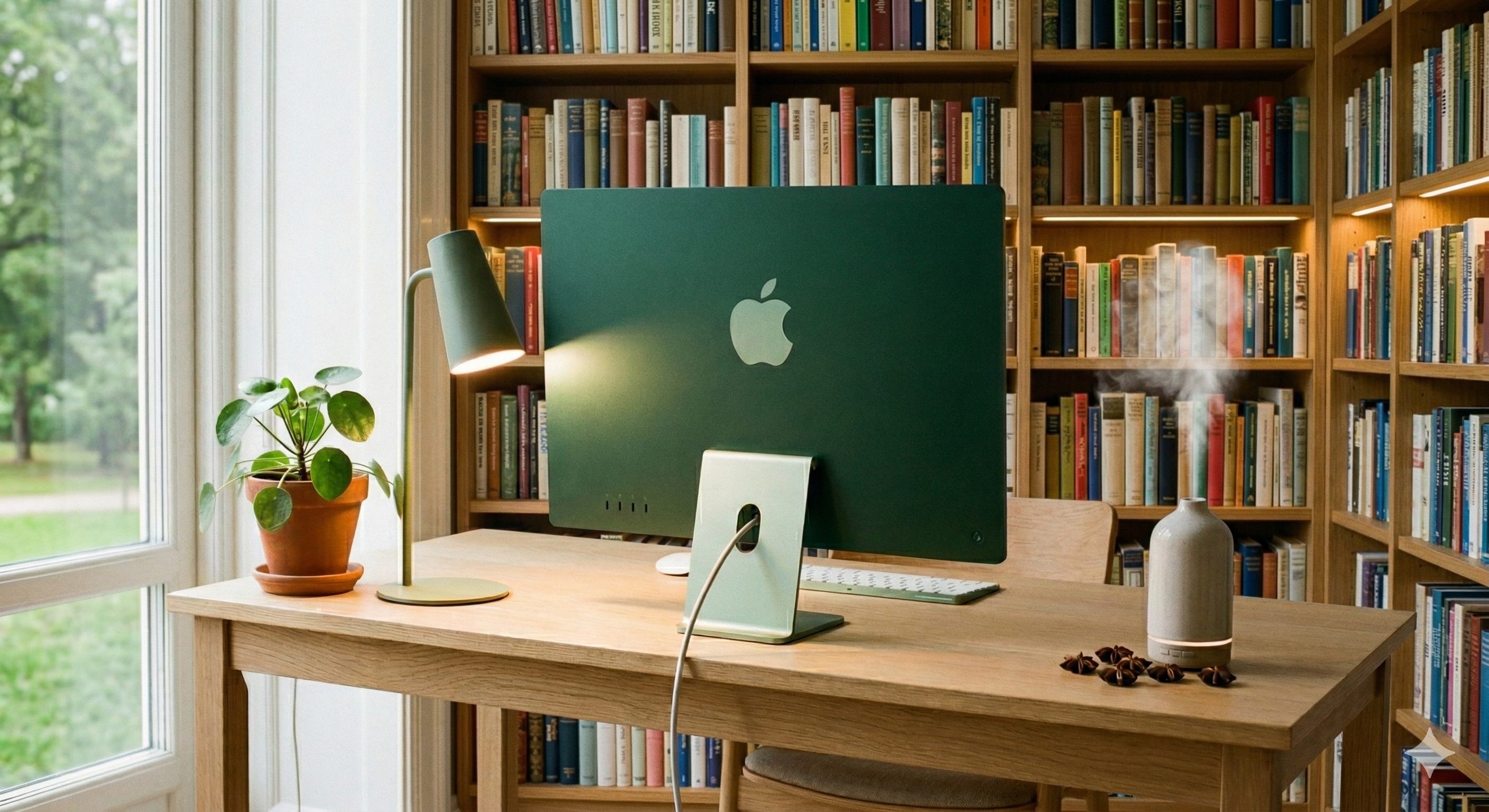
This is an AI-generated image of the kind of workspace we’ve been talking about.
What’s one thing in your current setup you would change first?
With love,
Cristina